Welcome to the Online Open Access Journal
+9190780 37929 [email protected]
Welcome to the Online Open Access Journal
+9190780 37929 [email protected]

Peer Review

The Peer Review Process: Ensuring Scholarly Integrity & Impact

Peer Review: The back bone to maintain Journal's quality

At Online Open Access, we employ a rigorous double-blind peer review system to maintain the highest standards of academic excellence. Our workflow is designed to be efficient, providing authors with constructive feedback while ensuring that only high-quality, original research enters the public domain.

  1. Initial Editorial Screening (Technical Check)

Every manuscript submitted to our Open Access platform undergoes a preliminary evaluation. The Editorial Office checks for:

  • Aims & Scope Alignment: Does the research fit the journal’s multidisciplinary focus?
  • Plagiarism Detection: We utilize industry-standard tools (like iThenticate) to ensure originality and prevent academic misconduct.
  • Formatting Compliance: Adherence to author guidelines and citation styles.
  1. Double-Blind Peer Review

To eliminate bias, we utilize a Double-Blind Peer Review model. Neither the authors nor the reviewers know each other’s identities.
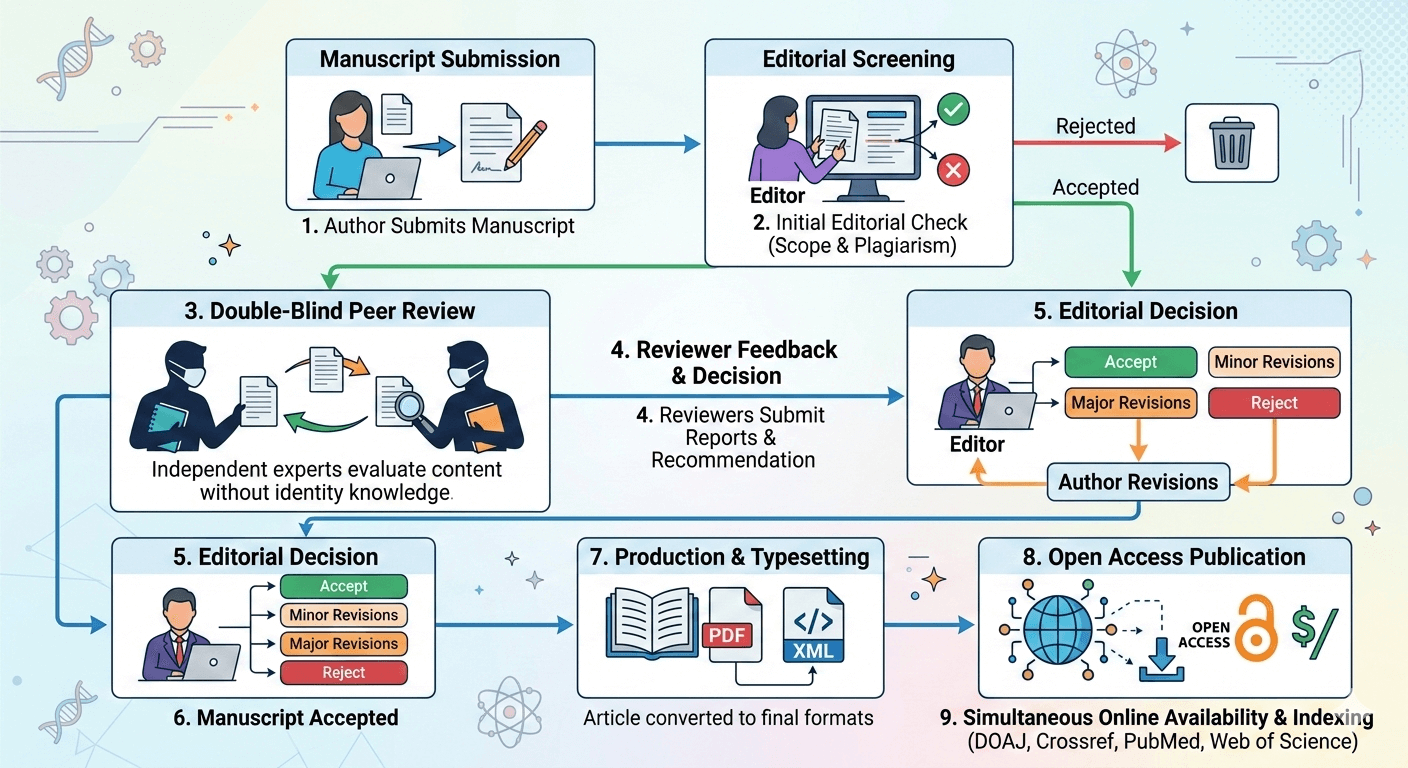
  • Expert Selection: The Editor-in-Chief assigns the paper to at least two independent subject matter experts.
  • Evaluation Criteria: Reviewers assess the methodology, data integrity, statistical significance, and the novelty of the findings.
Peer Review Process-Online Open Access

*This image an AI generated image using Gemini

  1. Editorial Decision Framework

Based on the reviewers’ reports, the Section Editor makes one of the following recommendations:

  • Accept: The manuscript is ready for production.
  • Minor Revisions: Small changes are required to improve clarity or formatting.
  • Major Revisions: Significant technical or theoretical flaws must be addressed before re-evaluation.
  • Reject: The manuscript does not meet the journal’s quality benchmarks or scientific rigor.
  1. Revision and Resubmission

Authors are given a specific timeframe to address reviewer comments. This stage is crucial for H-index optimization, as refined papers often garner higher citation impact once published.

  1. Final Production and Metadata Indexing

Once accepted, the paper moves to the production phase.

  • Typesetting & XML Tagging: We convert the manuscript into high-quality PDF and JATS XML formats.
  • DOI Assignment: Every article receives a unique Digital Object Identifier (DOI) for permanent tracking.

Global Indexing: The metadata is disseminated to Google Scholar, ResearchGate, and CrossRef to maximize discoverability.

Online Open Access Journal Logo SVG
JARM Agriculture Online Open Access Journal Logo
Society for Agricultural Research & Management (SARM) Logo
Agri Vision International Conference Logo
We are using cookies to give you the best experience. You can find out more about which cookies we are using or switch them off in privacy settings.
AcceptPrivacy Settings

GDPR